Can Beauty Make Us Good?
· The Atlantic
Subscribe here: Apple Podcasts | Spotify | YouTube
Visit turconews.click for more information.
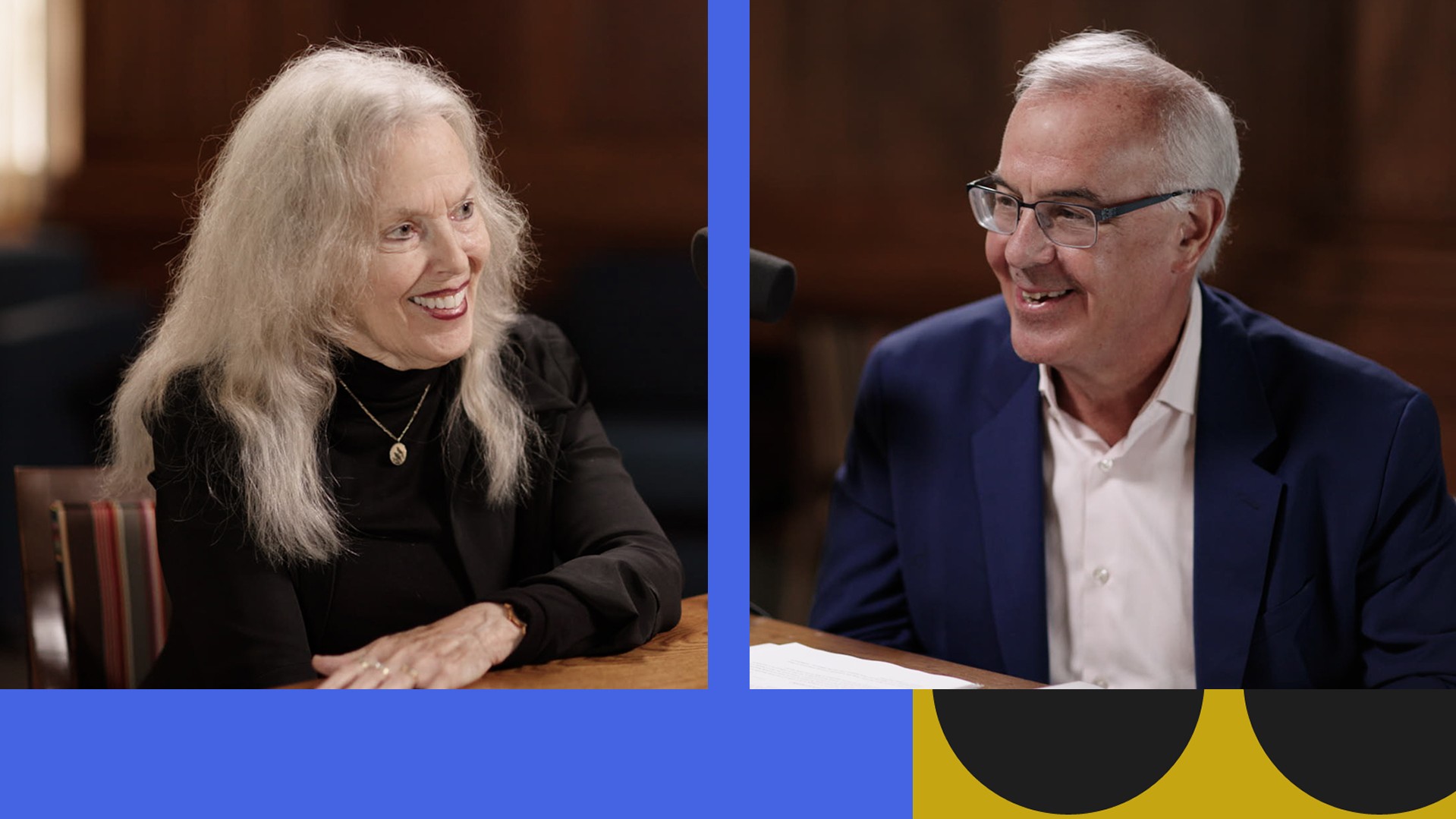
What is beauty? Is it really “in the eye of the beholder,” or is it an objective quality that exists in the world? Is it a mere decorative feature of life, or does it have something important to tell us? These are enduring human questions, but ones that the art world and the academic humanities—the natural custodians of beauty—gave up answering for a long time. In this episode, David Brooks talks to the Harvard professor Elaine Scarry, whose now-classic book On Beauty and Being Just brought the subject back to serious attention 25 years ago. David and Scarry discuss the ladder of loves, the universal appeal of symmetry, and why even prisoners at Guantánamo want to look at pretty pictures.
The following is a transcript of the episode:
David Brooks: Today’s episode is about beauty. The basic thesis of this show is that in our society, we have massive forces of dehumanization trying to shrink us and beleaguered forces of humanization. Nothing could be more humanizing than beauty.
We’re going to talk about how to cultivate a taste for beauty, how to create beauty, and we’re going to entertain the question: Does experiencing beauty make you a better person?
My conversation partner today is Elaine Scarry, a very eminent literature professor, a humanist. She has a fancy title here at Harvard University, the Walter M. Cabot Professor of Aesthetics and the General Theory of Value, which is a fantastic professor title.
Elaine wrote a very important book in 1999 called On Beauty and Being Just. It was an important moment because there was an assault on beauty and the very idea of beauty striking through the academy, through the art world. The idea is we shouldn’t create beauty. We should shock people into improving society. We should create ugly things to shock them.
In 1999, Elaine rose up to defend beauty, and I would say 26 years later, she has carried the day. Beauty is back on the agenda in the academy, in the artistic world.
You may notice that we are not at our usual set at Yale University today. We are at Harvard University. I want to reassure you that our podcast will not only be visiting colleges with gigantic endowments. We’ll be going to all sorts of places. I just happen to have a talk in Boston, so we thought we’d take advantage.
I’m David Brooks, and this is The Permanent Questions.
Brooks: Elaine Scarry, welcome to The Permanent Questions.
Today we’re gonna talk about beauty, which you have—I don’t know if you’ve single-handedly rescued it in the academy, but you’ve done your part. I have to confess to you: I am an aesthetic Philistine. I recall when I wrote my first book, which was published in 2000, I wrote it in a dank, unfinished basement of my home with mildew and the smell of mildew everywhere.
My desk was a plywood board, and my chair was a folding chair, and it was just me and my little laptop, and I was oblivious. I didn’t care. A lot of people were like, “I’m not working here.”
But even I occasionally have these moments when you’re undone by something tremendously beautiful. I think the thing that strikes you about them is they lift you out of everyday reality for at least a brief time.
You’ve done so much work on beauty; you must have had encounters of that sort with beauty.
Scarry: I have had many encounters. I think that over time, the longer one lives, the more encounters one has, not just because they can keep accumulating and adding up, but because one learns to see or one becomes aware of just the astonishing plenitude that’s all around one.
A kind of interesting analogy is what happens with color vision. John Dewey says that if you give small children the chance to learn color, it usually takes several years to be able to reliably identify a color.
Whereas now researchers say that as adults, the average number of colors we can all see is 26,000, and if you count gray tones, it’s closer to a million. I think that something like that happens with beauty. You may not be aware of it as a child, or it may be happening to you, but you don’t have words for it.
My partner and I often read books aloud. At one time, he was reading The Tale of Genji for about 20 minutes each morning. When he would begin to read, Lady Murasaki’s writing immediately lights up your mind. I would see pools of color that weren’t even directly prompted by what was said on the page.
She’s writing about the court in Japan, but at the same time, Genji is always discovering beauty anywhere, in the outskirts and among poor people, and so forth. That kind of experience with reading is one that I’m sure we both have.
Brooks: When you mentioned the ability to perceive more colors, there’s a neuroscientist at Northeastern named Lisa Feldman Barrett, who has a concept of emotional granularity. She says that some people can only experience very crude emotional categories. They know what’s an up state or a down state. But some people have the ability to distinguish between adjacent emotions like stress, anxiety, frustration, fear. They can make these fine gradations.
Emotional granularity helps you read your own body, and maybe color granularity helps you see the world.
I’m gonna quote you back to yourself: “Beautiful things have been placed here and there throughout the world to serve as small wake-up calls to perception, spurring lapsed alertness to its most acute level. Through its beauty, the world continually reconnects us to rigorous standard or perceptual care.”
I like that phrase “perceptual care.” Perception isn’t just a passive process of opening our eyes and things come in. There’s something you can do to make yourself more perceptive or receptive toward beauty.
Scarry: When you suddenly come face-to-face with something beautiful or it suddenly enters your world, you may have been thinking that you were fully awake and perceptive and listening and hearing and so forth, but one of the effects of beautiful things is to just really raise the level of perceptual acuity.
It sets a new standard or a new bar, so that you realize that you should be giving that kind of attention to other things in the world that don’t necessarily come to you with such glory but that nonetheless deserve your attention.
Brooks: It’s almost like an energy is being produced.
I took my favorite drive in America two summers ago, down from Missoula, Montana, down the Salmon River to Salmon, Idaho. It is astoundingly beautiful. When I got out of the car, my wife and I were at some crappy hotel or something, and I’m buzzing with energy. If you see bluebirds in love, they’re bouncing all around each other.
I look back almost with embarrassment at how excited I was to just have had this astonishing drive where you’re going through this valley, and every curve brings about a new scene. And it’s—you’re just energized, almost like puppy love or something.
Scarry: There’s a wonderful poem by Seamus Heaney, I think it’s called “Postscript,” where he describes driving with his wife, Marie, along, I think it’s the west coast of Ireland, and the beauty of the wind and the water. And he says: No use in stopping the car. I find that same kind of event happens even when you’re moving through the world. Seamus Heaney’s poem ends by saying, It blows the heart open. I think that’s a very good description.
Brooks: It’s a weird concept. It bleeds into everything. People perceive beauty in a million different forms. Yet we all call it one thing.
We have a mutual friend, Brandon Vaidyanathan, who’s a sociologist at Catholic University. He did this big study of beauty, talking to scientists: “Are you motivated by beauty?”
Some of them describe beauty in conventional terms, but some of them described beauty just as understanding. They are motivated by a beauty to understand, and they use that aesthetic language to describe just understanding an engineering problem or a math problem.
Scarry: I’ve talked to scientists, and they do have different accounts. My friend Barry Mazur, who’s a mathematician, says that every solved theory is beautiful. It’s not that it has to be beautiful. It just happens to be the case that it is beautiful. Somebody else in the physics department who works on electromagnetic subjects says that he counsels his students, “Just because you’ve got a pretty theory, don’t think it’s true.” Whereas somebody I once spoke with at Yale who was in chemistry told me that he thinks that if a hypothesis is pretty or beautiful, it increases the chances that it’s true.
So there’s really a wide range, from the one person who thinks, In every case, it’s beautiful, but there’s no reason why that should be, to somebody who actually thinks it predicts.
Brooks: When we talk about a beautiful landscape, a beautiful face, a beautiful equation, are we talking about the same thing? What is the core concept here?
Scarry: I think we’re definitely talking about the same thing, even though there’s tremendous variation, and certainly variation in the things that most strike people as beautiful.
But one thing that they all share, which is foregrounded in the math example, is the idea of symmetry or proportion. It’s just so deeply there. I think of a text that I love that really makes that clear, St. Augustine’s “De Musica,” where he’s talking about equality as a feature of God, and he talks about the fact that you can see it in human faces.
You can see it in dance steps. You can hear it in music. He even gives examples like a cake or feeling the softness of another person’s body—that what you’re feeling is equality, which isn’t normally how we would think of smooth skin, but he says that’s equality that you’re experiencing.
It’s startling. He’s not making a plea for democracy, but he is talking about proportion. He even says, by the way, that color—like the color of your jacket, the fact that it’s a uniform blue, or the sky is, at least in patches, a uniform blue—is an example of equality and the tremendous pleasure that brings.
When you hear scientists—like one scientist who’s written a book about beauty in science is named Mario Livio, and every example he gives has got startling symmetry in it.
There are other features as well. For example, intensity and vibrancy. I think that the quality of aliveness is absolutely key in all the examples.
Brooks: Do you think that our sense of beauty is somewhat evolutionarily baked in? Symmetry probably has some survival advantages. You want people who have symmetrical faces, and people look at body shapes for fertility signs. That suggests there’s some universal sense of what beauty is, that all humans would see the same face and think, “Oh, that’s beautiful.”
Scarry: I sometimes have people say to me, “Well, there are famous faces, famous models who have a kind of asymmetry in their face.”
That’s true, but it’s a .00001 asymmetry. The important thing to realize, as you said in your description, is that if a face is really nonsymmetrical, there’s no way that it can be in the neighborhood of beauty.
By the way, I think that is a partial answer to your question about evolution. Yes, it may be that we’re like butterflies and birds. It’s been said of butterflies and birds that they keep getting more and more extravagant because the females choose the males on the basis of their beauty and so forth.
There is probably some kind of reproductive bias, which might also be true of human beings. But I think that part of the reason that beauty is so important to us is because it is opposed to injury. It makes us deeply averse to injury. It acts on us so that when we see someone who’s injured, we know the first thing you have to do is try to repair it.
It makes us, or should make us, hesitant about inflicting injuries on others. How could you survive as a species if you didn’t, overall, have a kind of aversion to acts of inflicting injury?
Brooks: I want to get to the relationship between beauty and morality in a minute because I think that’s a central subject here. But I want to stay on the experience of beauty just a little longer. You use a word that I’d like to hear you expand upon. You say beauty is “lifesaving.” What do you mean by that?
Scarry: Here’s an amazing fact that I learned relatively recently. In the early ’80s, a researcher in Sweden looked at the people in hospital who were recovering from surgery, and half of them had a window that looked out onto a green grove, and the other half had a window that looked out onto a brick wall. And those in the room with the green window got better much more quickly.
It makes you realize that we might not have it right about what beauty is, but we better try and get it right, if it actually leads to people being able to more quickly recover.
Every couple of years, the American Society of Civil Engineers gives a report card to our bridges, our highways, our levies, and among other things, our public schools.
I just looked at the one for 2025 because I knew I was gonna be speaking with you. And though the general drift of the whole overall report card is to go up—I think the overall grade in 2025 went up from a C- to a C. The public school, and they’re talking not about teachers, but about the physical environment, they give the grade of D+.
Brooks: When I read that lifesaving line, I thought of someone I admire a great deal, which is Tina Turner, the singer.
Her story is really built around beauty. She really had this sense. She grew up in Nutbush, Tennessee, to a dad who left her and a mom who was somewhat narcissistic and also left her, and she could sing. And so this guy Ike Turner finds her; realizes, That’s my million dollars; and basically enslaves her.
He doesn’t pay her. He beats her savagely. He commits adultery on a mass scale, has mistresses living in their house with them. Just a brutal life. The wedding that he proposed—took her down to Tijuana, no dress, no kiss, just a civil ceremony, and then he took her to a whorehouse and made her watch a sex show.
Her life was just brutal under him. And at one point, she attempts suicide. She’s ready to go. She wakes up in the hospital. Ike is furious at her for upsetting his budgetary plans. But then she decides, “What did I want when I was a girl?”
She always loved beauty. And so she started doing these Buddhist practices and doing floral decorations and keeping a journal. She built herself up to be the kind of person who could stand up to Ike Turner, and it took her 14 years. But she eventually fought back, and eventually ran away, had her own career, became a superstar, age 60, a sexy rockstar lady.
Then she got remarried, and at her wedding, she insisted there be 100,000 roses. When I read 100,000, I went, “That’s a lot of roses.”
That must’ve cost a fortune. But she had rebuilt her life on the basis of creating beauty. And as a rebuttal to her first Tijuana wedding, she was gonna have 100,000 roses.
Scarry: You can destroy all fairness. It sounds like her husband had managed to completely eliminate any sense of fairness in their household. It’s hard to completely eliminate beauty. There’s often something flying by the window.
Once when I was in Geneva and talking with the International Red Cross, one of the Red Cross workers said that she had asked a prisoner at Guantánamo if there was anything she could bring him, because that’s often something the Red Cross offers. One prisoner said that he would like a photograph of a flower. Another example of Tina Turner’s solution to the problem she was in, where you’re really trying to make yourself believe that there still is symmetry and vivacity in the world.
I was once at a conference in England, and there was a young woman who had studied Romanian prisons. It was a women’s prison that she was studying. The women would take tiny little threads from their undergarments and weave little tapestries one inch by one inch and give them to each other. They treasured that and survived by means of it.
Brooks: Maybe this is wrong, but it seems to me it’s not quite controllable, that you can put yourself in the way of beauty, but you can’t say, “I am about to be overwhelmed by beauty the next time I walk down the street.”
Scarry: There are reliably beautiful sources that one can go to. Like returning to Tolstoy’s War and Peace or going to a particular street that you loved in your childhood. But often the beauty does also suddenly vanish.
I usually teach a graduate course on beauty, but occasionally I’ve taught a freshman seminar on beauty, and at one point one of the freshman who was very interested in the beauty of design, in an iPhone, for example, surmised that the fact that beauty often doesn’t last forever—it might last three seconds, it might last three years, but it often goes away—then leads us, as I wrote in the book On Beauty and Being Just, to the act of creation.
It’s a kind of instigation of creation and a kind of passing on of beauty. So you could say we compensate for the brevity of beautiful things or the short life of flowers, or you could say it’s actually an okay thing that it’s so short because that instigates our own acts of creation.
Brooks: One more piece of the perception of beauty that strikes me as incredibly important these days is amor mundi—love the world. Imagine if we were surrounded by nature that was hideously ugly.
We would feel alienated from the world; we would feel this is not a home. The fact that it is a beautiful place makes us feel at home and love the world.
You quoted Augustine. I love Augustine, so I’m going to quote him: “I asked the Earth, I asked the sea and the deeps. Among the living animals and the things that creep, I asked the winds that blow, I asked the heavens, the sun, the moon, the stars, and to all things that stand at the door of my flesh. My question was the gaze I turned to them. Their answer was their beauty.”
Augustine is such a poet, but one of the things that strikes me as important: I’ve been at three different colleges in the past week, and at each college, the students in front of me, not with my participation, got in an argument about how rotten the world is. A lot of them think it’s completely rotten, whether climate change, AI, or everything, just the whole world’s been ruined for them. Some think it only marginally rotten.
That rotten-world syndrome—they may be right, they may be wrong, but it’s not a positive way to go through life. If you want to change the world, it seems to me you want to love the world.
I think the beauty of the world makes us feel at home. There is a sort of homecoming feeling about beauty that makes you think, Yeah, this is my home. This is the beautiful place that I get to spend my life. Without that, it’s almost hard to have hope.
Scarry: One of my students, long ago, back in the 1990s, said, “Beauty restores your trust in the world.” So you can be attending to very harsh things, and suddenly you see something, and it restores your belief in the world.
Now, I do think students are really facing a triple decker of problems. And yet, like you, I think, How can we even have a planet this beautiful? Is it just that we’re designed to appreciate it? Those other planets, by the way—has anyone actually noticed what they look like? The Earth is almost incomprehensible in how beautiful it is. But I think that, gradually, students will be sensitive to that and will feel some kind of resilience about what’s happening.
Brooks: When I talk about the students, they’re always the hero in my story. Today’s students have been put in a very challenging circumstance, and they’re fighting back the best they can.
But I sometimes think they are too pessimistic about the world, and I say, “Read history.” What decade would you go back to? Things have always been pretty rotten. Before we leave this, I just want to ask you about one concept that I know very little about. I had a friend who was an opera singer who was a fan of duende, the kind of beauty that’s intermingled with sadness.
We can all think of songs and poems that embody this. What strikes me about this whole conversation—we’ve had the perception of beauty. You can go through life with a very utilitarian frame of mind. It’s all material. And what beauty does is it reminds you the world is not strictly a utilitarian, material place. There’s an enchantment, at least in our perception of it.
Scarry: Many, many poems, or the music you’re describing, might be about subjects that are sad. Like the passing of the year in Keats’s ode “To Autumn” that’s also so unbelievably gorgeous. Or many elegies that are obviously full of sadness, and yet are very beautiful.
Aquinas says that even something ugly if rendered in a beautiful artwork can be beautiful.
Brooks: I was at my folks’ home, and they had some guests coming over from France, and there was a woman from Paris. This was her first trip to New York. And they said, “How’d you find it?”
And I love New York. I’m a New Yorker. But she said, “Well, I didn’t realize it’d be so ugly.” And I was like, “It is kind if ugly, but the ugly parts are the parts I like.” If you love the ugly parts of your place, you love the place.
Scarry: I guess you have to find a good path in, because usually when I’m coming in, I get out at LaGuardia, and it just seems like I’m always coming down a very tree-lined street with brownstones, and I think, “This is a very beautiful city.”
But your story puts me in mind of a friend who always loved New York, who went to Rome, and suddenly would have nothing more to say good about New York.
Brooks: Washington, D.C., where I live, is supposed to be Paris. When we go to Paris, I think, Oh, we’ve got a long way to go. I’m not endorsing Donald Trump’s arch, by the way.
I ran across the work of an anthropologist named Ellen Dissanayake, and she wrote a book called Homo Aestheticus. She makes the claim that human beings have a natural desire to make special, and she means to make special sacred occasions, to—when you go to a fancy party, you dress up. You want to make it special. When my wife gets home, the first thing she does is get out her Trader Joe’s flowers, which she has just bought. She lights eight million candles. She sets the table even though she hasn’t cooked the meal yet. She wants to make the occasion special.
This is something in us. We want to have special occasions, rituals, and we use beauty to create them. It seems to me like that’s what a wedding is all about, or anything else. I don’t know what you make of this impulse towards specialness.
Scarry: Well, it sounds immediately convincing. One recognizes it in practice, and also, I think, I understand how it works. Given the tremendous pleasure that beauty brings, you just want people to have that pleasure when they can.
There’s a statement by Kant, who says that a lot of different things give pleasure, but they have an end point. You’re hungry, you have a good meal, and so forth. But he says that the pleasure of beauty is inexhaustible. You never get tired of it. You never have enough.
Brooks: This reminds me, you’ve also done some work in your career on Boethius. I was reading his book The Consolation of Philosophy. He’s got a passage on what you should orient your life toward.
If you want money, you’ll always feel poor. If you want power, you’ll always feel weak. If you want status, you will always be the victim of other people’s opinions. So he’s really saying, “Don’t want these finite goods. Want infinite goods.”
There’s a famous commencement address by David Foster Wallace at Kenyon College, where he says, Everybody worships, but if you worship money and power and status, you’ll always feel inadequate. If you worship looks, you’ll die a thousand deaths before they bury you. When I read that David Foster Wallace speech, which I’ve read many times before, I thought, “He must have read Boethius.”
Scarry: He probably did.
Brooks: But it is a good way to orient our lives. If you orient toward finite things, you will run out. But beauty, belonging, competence, respect, significance, meaning—these things are infinite goods. It’s probably a good idea to orient your life toward the infinite ones, because you’ll never run to the end of them.
Scarry: I was just having a conversation with my brother Joe and his partner, Rachel, who’s a pastor, saying something kindred to what you were saying.
She quoted this passage that I didn’t know from Philippians chapter 4. Paul says: Finally, brothers and sisters, when you come upon something excellent or something kind or something lovely or something true, think on it and the peace of God will be with you.
Brooks: I think what your most daring claim may be, or one of them, is that beauty contributes to virtue and to better behavior.
Now, I desperately wanna believe this. But when I think on Italian Renaissance art, there’s a lot of beauty being produced, but I wouldn’t say when I go back to those city states, the history of it, that the people were necessarily living in a more just and fair and kind way.
Picasso produced a lot of beauty, but what I know of his life, he was a bit narcissistic. A lot of people who organize their lives around beauty don’t seem so great to me.
Scarry: The same problem can be seen in literature sometimes. There are cases where people are known to have been just good, kind people, like John Keats, but then there are other examples where they’re known to be closer to Picasso.
But I think that the way that beauty brings about morality is not necessarily so one-to-one: This person at this moment sees something or creates something beautiful; therefore, they’re good. However, there certainly are cases like that all the time. When I read that study that showed the way that your physical health is improved if you’re in the presence of beauty, I began to wonder, Is that also true for moral health?
Because certain places like in Denmark—they actually put prisoners in lovely spaces, very antithetical to the kinds of prisons that we often have in the United States. The assumption is that if you want people to be able to grow or to change, they have to be in a lovely space.
Which I think goes along with one of your favorite writers, Simone Weil, who says that you are decentered by beauty. That is a profound effect that you actually undergo this launch from what you thought was the center of the world off to the periphery, and you’re really happy about it.
That’s the amazing thing.
There are lots of things that make us feel ecstatic, and there are lots of things that make us feel subordinate. But usually, at the moment you’re being made to feel subordinate, you don’t feel ecstatic.
But back to the kind of example you give. I just think that it’s more a drifting process, that having beautiful things in the world has an overall effect of diminishing the urge to injure.
I’d have to really look at those specific periods to see if I agreed that they were ruthless, because sometimes people make that argument about historical periods where I just think it’s completely false.
For example, people will often say Hitler loved beauty. My own view is it’s a scandal that this many years from World War II any of us are saying Hitler liked beauty. That is not somebody who liked beauty. People seem to have accepted his self-definition. I use the metaphor of saying: If you had somebody who actually broke the legs of 100 ballerinas and then held up a postcard of Degas and said, “I really love ballet,” you wouldn’t for a moment say, “Ah, that person loved ballet.” You’d say, “I think the person didn’t love ballet.”
Brooks: Yeah, I would say, from what I know, his aesthetic sense, or Albert Speer, the architect, it was pretty representative of his belief system. The urge to dominate is in the architecture. It’s meant to be overpowering and not exactly subtle.
You mentioned Simone Weil, and we’ve taped I don’t know how many episodes so far, and her name has come up more than anybody else’s. It’s not only because I’m projecting out unconscious Simone Weil vibes that I want people to talk about her. It’s something about her attention to attention as the ultimate form of generosity, and then the way she inspired Iris Murdoch to see the act of attention as the primacy of morality.
She writes, “You can grow by looking.” The seeing is a moral act even though it is not an act. You’re not even touching anybody.
Scarry: That is a wonderful passage. There’s another moment where she talks about feeling self-absorbed, feeling that she’s not being treated well enough by her colleagues, and then seeing a bird, like the bird that came into the presence of your friend and suddenly just undergoing this un-self thing.
I think people don’t realize when they don’t see generously that they’re also doing themselves harm. They’re really hurting their own soul.
Brooks: I’ve always been struck by the fact that the philosophers and writers who emphasize attention most—obviously Weil and Murdoch, but I would also throw in Edith Stein as an example. I would also throw in Marilynne Robinson as an example, whose book Gilead is really a description of somebody looking.
And for those who haven’t read it, and I highly recommend you read it; it’s about a guy named John Ames who’s old and dying, and he’s married a much younger woman, and they have a little boy, a 9-year-old boy. He wants to leave a letter to the boy so he knows his dad, because John Ames knows he’s got weeks or months to go, but all he does is look at him.
The novel is really just John Ames looking at this wonderful creature, an ordinary 9-year-old boy. And there are two passages, quick passages, from John Ames, writing this letter to his son that he’ll get after he’s dead.
“I’m writing this in part to tell you that if you ever wonder if you, what you’ve done with your life, and everyone does wonder sooner or later, you’ve been God’s grace to me, a miracle. Something more than a miracle. I can tell you this, that if I’d married some rosy dame,”—I’m having trouble getting through this—“and she had given me 10 children, and they had each given me 10 grandchildren, I’d leave them all on Christmas Eve, on the coldest night of the world, and walk a thousand miles just for the sight of your face and your mother’s face.”
It’s just a description of: I’m looking at you, and I’m overwhelmed. It’s a beautiful book because of this guy’s capacity to look.
Scarry: That’s an extraordinary passage.
Brooks: But the question I have is: I’ve thrown out four names, Murdoch, Weil, Edith Stein, and Marilynne Robinson, and is it a coincidence they’re all women?
These bachelor male philosophers like Kant, they thought morality was action.
And the women had a quieter, “Oh, no, it’s perception.”
Scarry: The labor of perception.
Brooks: It doesn’t strike me obvious that it’s a mere coincidence. There were others among Irish Murdoch’s philosophy circle out there in England in that World War II era; they’re a big famous group of women philosophers.
Scarry: It doesn’t seem an accident that they’re women. Now, there are men who I think see in the same way. I’ve mentioned Seamus Heaney, and Thomas Hardy, I think, is another person whose perceptual acuity and recognition that perception is everything. I do have to report that some of the most ethical people I know in my life have been men.
So I always have to stop short of—
Brooks: —blanket condemnation. That’s my male self-loathing. I didn’t mean to imply that. But I think all generalizations go away.
So the first argument that it could make you a better person is the fact of decentering. You’re looking outward and, as you said, feeling marginal and wonderful at the same time.
But the second argument would be, and that you’ve made this argument, that there’s something about the shape of beauty, the symmetry. I think Aristotle has some concept of justice as a cube or something like that.
So there’s something almost about the shape of it that gives form to goodness.
Scarry: I think it is the symmetry issue. Every concept we have of justice, every theory I can think of that’s about justice, stresses that idea of symmetry.
The best-known theory today is John Rawls’s theory of justice, and he says that fairness requires a symmetry in all our relations with other people. Plato talks about how you have to have punishment that is symmetrical to the crime and here we are, hundreds and hundreds of years later, and we haven’t figured out yet what is the right kind of punishment for a crime. Or people talk about how you have to have a kind of equal pay for equal work, and it always involves that idea of symmetry. With beautiful things, it’s effortlessly there in many, many manifestations.
By the way, many people say to me: “Well, there are wonderful paintings that are asymmetrical, and so forth.” That’s certainly true. But there are two things about that. First, the fact that we can feel so secure that we can go on to discover beauty in something like an asymmetrical abstraction, that is a kind of celebration of how sturdy the foundation already is. And then the second thing is that—and here you may not agree—we’ve so lost the ability to think symmetrically in the United States.
I mean, the idea that we went after Iran for thinking about making a nuclear weapon when we have thousands of these. We have between 800 and 900 military bases in the world, and we report in our newspapers, “Oh, China’s getting another military base.”
And of course, wealth. I think that if we ever had to start stressing symmetry, and I believe we should start stressing symmetry, we would have to change a lot about what we do, the distance between the richest and the poorest people.
Brooks: So you’re saying that just the asymmetrical nature of American power, or of concentrated wealth, or I could say even of status in this country, you’re asking for trouble when you—
Scarry: You’re asking for trouble. You’re making it harder and harder for people to act well. Aristotle says, “A just society is a society that makes its population care to be just.”
You know, we can argue about whether the government in this country is just or not; probably, we wouldn’t have a big argument. But the real question is: Do we as a population care to be just? Do we really worry about the asymmetries?
Brooks: What about the argument that, say Sergey Brin or Larry Page, these Google guys, created a search engine that produced such an enormous amount of good for the world that the money they earn is symmetrical to the amount of good in the world that they’ve produced?
Scarry: Certainly you hear many variations of that. If somebody has made a great invention, it’s at least a momentarily plausible argument. But I guess you’d have to begin by saying there are many versions of that that just say, “I’m the one, who as the executive in this company, is putting in all the value.”
This was Marx’s argument, that the surplus value came from all the workers and yet was appropriated by the owner.
Brooks: When we talk about beauty, we’re not only talking about symmetry; we’re talking at some sense about reciprocity, proportion.
One other thing I’d mention: We love movement without change. I have a place on the Chesapeake Bay in Maryland, and I love to watch the water, and it moves, it ripples, but it doesn’t really change.
There’s something I find tremendously attractive about watching the ripples of the water stay the same, and it’s the same when you look into a fire. The flames of the fire are flickering, but they’re the same.
Scarry: I remember a passage in Rachel Carson, The Sea Around Us. She of course talks about great movements of water and these big circulating tides. But also talks about whether in these wavelets, whether the water is actually moving or whether it’s passing something on. And I have kind of the equivalent for that. I don’t think I have the steady access to bodies of water, although I should. I live about a block from the Charles River, so I’ll have to rethink my daily habits.
But I have something the same with wind—just being amazed by the fact that in one willow tree, one rope of branches is doing a kind of motion like this, and another is doing a very different kind of thing like this, and there are about 15, even within the small micro world of individual pockets of branches, and it is extraordinary. And I guess it would fit your model, since the willow tree itself doesn’t move up the block.
Brooks: That would be scary.
Maybe we should hire artists to look at society and do an analysis of where the symmetries and reciprocities and proportions are.
You had said something a few minutes ago, which I find to be the most persuasive argument of how an aesthetic sense can lead to better behavior. What you said strikes me as very accurate. It’s not like you look at a Vermeer painting and then you go out and save a kid who’s drowning or whatever.
It has a gradual effect. You throw yourself in the way of beauty. You see a beautiful mountain, a sunset. You go to an art museum. I think it has a gradual ennobling effect. It would certainly seem obvious to me if you put crappy art in front of somebody for their whole life. It would have some degrading effect on their inner nature. That some beautiful effect would have a more illuminating effect. You’re looking upward, and you’re yearning for something that’s beautiful.
We use the phrase “moral beauty” just as much as we use the phrase “physical beauty.” And so it has a slowly ennobling effect, I would think.
Scarry: I think that’s absolutely right.
Brooks: You know, we say somebody has a beautiful soul. I think what we mean by that is somebody’s kind and forgiving and warm, and so it’s funny how we use this word across so many contexts.
Scarry: There’s a book by the historian Lynn Hunt that talks about the effect that novels had in the 18th century, when suddenly people would read a novel and realize that the maidservant had this whole inner life that had just never occurred to them before. A kind of real perceptual revolution came about by the widespread reading of novels.
Brooks: Harriet Beecher Stowe gets a lot of criticism these days for Uncle Tom’s Cabin, but it did have a pretty amazing effect.
Scarry: It doesn’t get better than that in terms of trying to repair a massive asymmetry and a massive ongoing injury.
Brooks: I think also beauty can arouse a desire to lead a more beautiful life. If you surround yourself with beautiful things, you may not automatically become a deeper person, but beauty arouses, you keep using the word vitality. I wanna come back to that word. Beauty and desire go together.
Almost by definition of beauty is a thing we desire and take innate pleasure in. So to me, it would have a form of lifting your life up just because you’re used to looking upward, basically, at things you admire.
You mentioned how older people have maybe a more refined sense of sight sometimes.
Scarry: I don’t know if it’s more refined, but I think that they’re struck by beauty more often. When you’re my age, it’s hard to get from A to B without thinking, Oh my gosh; just you suddenly see something you hadn’t seen before.
For example, it’s only in the last couple of years that I’ve noticed that when leaves start turning, there are certain leaves that sort of recreate the shape of their own self in a little portrait of a different color on the leaf. It’s not every tree; it’s only certain species, but it’s heart-stopping when you come upon it.
Brooks: Do you think earlier in your life you were just in too much of a rush or …?
Scarry: Not a rush, no. I don’t know what it is. I think I liked beauty and sought beauty, and that’s what brought me to the humanities, no doubt. It’s what makes me love glass, beautiful colored glass, whether it’s in a cathedral window or in my own window in a little vase. As a gardener, I’m willing to be the servant, happy to be the servant of the flowers.
I’m just saying there are many more objects, many more people. I mean, sometimes I look at, you know, a room full of people or a class of people, and I just think, How can every face be this beautiful?
Brooks: There is research on where they have younger adults and older adults look at crowds, and they follow their eye saccades to see where they’re going. And the younger adults are looking at the threatening faces, and the older adults are looking at the happy faces. It sort of makes evolutionary sense.
The younger adults are out there to protect the community, and the older adults have passed that responsibility on. But it’s one of the reasons that emotional health improves with age. You’re much more open to positive emotions.
We’ve talked about the aspect of having taste, and we’ve talked a little about how it’s formed, probably influenced, anyway, by evolution—that we like symmetry, we like these things.
But it can’t only be that. There must be a way to educate your taste, Do you agree with that? Do you think there are ways to improve the way you see a piece of art or anything, or even taste a glass of wine—like sommeliers talk about wine. I’m like, “Well, I don’t know.” I don’t have that, the concepts that they have to describe what a nutty glass of wine is. So there must be a way to educate it.
Scarry: So many instances of beauty come, just as you described earlier, in a way that surprises you, come out of nowhere. But then there are things that are difficult. One of Plato’s dialogues called Greater Hippias, or we think it’s by Plato, ends by saying beauty is difficult.
There are a lot of forms of beauty or instances of beauty that are difficult. Not everyone can pick up Marilynne Robinson and immediately see the power of it. Many books, many classrooms are dedicated to that process of trying to discover the beauty of the thing.
By the way, I agree that somebody can teach me to actually taste what’s in the wine in a way that I can’t unless they begin to describe it to me. But one reason why I am a little uncomfortable with the word taste is just because it implies that there is a right way to respond.
And I think that the beautiful things in the world fall into two categories, which sounds like a ridiculous statement, but for the moment you have to allow it. There are some things that are universally beautiful; like there’s no one on Earth who has not noticed a sunrise or a sunset. Same with the moon.
They give us the idea that beautiful things are gonna be universally adored, whereas that simply isn’t the case. We each choose a different partner and therefore we’ve each come to see the beauty of that person’s face that other people won’t agree with. It wouldn’t be good if we all chose the same person.
I call all the plural objects “the myriad variables,” and ones that are universally shared, “the constants.” By educating one another’s taste, in addition to the sheer pleasure and whatever growth or care comes from that act, that it also is making us take one tiny step closer to believing that we could on Earth settle our differences that are causing so much strife. To find an object that I at first didn’t see and that you showed me or vice versa means that you’re restoring faith capacity for shared consent.
Brooks: It strikes me there’s two ways that might work, one of which I would support. The one I’d be skeptical of is just the statement: “Well, different strokes for different folks, and beauty is in the eye of the beholder.”
It’s all subjectivity all the way down. And therefore we should be tolerant. I think that’s sort of an unrealistic way to think you’re gonna have a harmonious society.
If somebody came up to me and said, “You know, my garden gnome is a more beautiful work of art than your Vermeer,” I would have a negative view of them.
I’ve been trained by my culture to have a certain aesthetic standards that some things genuinely are more beautiful, that the beauty of a Vermeer painting is not in my eyes. It’s in the painting.
A community that has a shared aesthetic order is healthy in the way a community that has a shared moral order.
You know, we’re all different, but we agree on what’s right and what’s wrong. And it seems to me that’s a better way to regard aesthetics—as something which does have a hierarchy.
Scarry: But here’s the thing. Each little object along the way is just leading to a larger vision.
I’m also opposed to garden gnomes, but if somebody gets the next step by doing that—that’s Plato’s ladder, that eventually you go on to being able to see and to create laws and literature and all kinds of marvelous things.
Brooks: You mentioned one of my favorite concepts in philosophy: Plato’s ladder of loves. Could you just describe what Plato was saying there?
Scarry: This occurs at the end of Plato’s Symposium, where everybody who’s there has just given their account and a kind of written a praise poem to love. Toward the end, Socrates gives his account and shows that actually love often entails lack.
He then tells that his own teacher is a woman named Diotima, who explained to him that you begin by, through the beauty of your beloved, falling in love with one person, but that eventually you learn to see the beauty of all men and women. So you pass from eros to caritas.
Then you also love a lot of things like education and legal treatises and many other beautiful things.
Brooks: I’m a big Augustinian, and his whole moral system is built around that there’s an order of loves. If you tell me a story in private and I blab at a dinner party, I’m putting my love of popularity above my love of friendship, and that’s disordered love. If you lie to make money, you’re putting your love of money above your love of honesty. That’s disordered love. It’s a useful way to think about what wrong behavior actually is.
I’d like to talk to you a little about desire and beauty. There’s a couple, the Arens, they study relationships. One of their theories is that the thing that gives us greatest pleasure is self-transcendence, the idea that we incorporate otherness into ourselves and we grow. We have this fervent desire to keep growing.
Their theory is that the rush of excitement you get when you fall in love is from incorporating another person into your psyche. That process is intrinsically interesting and intrinsically exciting. I like this concept of desire as self-transcendence, because when you look around, whether people are reading a book or going to a museum, we’re trying to grow. There seems to be some intrinsic pleasure in that, aside from the beauty of whatever painting we see—the act of learning is its own aesthetic thing. I think it’s one of the most holy desires that we have.
Let’s take the problem of beautiful people. One could say we’ve been praising beauty, but we already overvalue beautiful people. We pay them more. We attribute all sorts of positive attributes which they may or may not possess. So beauty can be a seduction to overvalue something for superficial reasons. Would that be fair to say?
Scarry: That would be fair to say, but I think that probably we could develop a more positive picture of this. Only when you’re talking about the beauty of persons does it start feeling a little bit problematic.
Often there’s a kind of impatience with the person because he or she doesn’t have the same kind of inner beauty. That is, we assume the person will have inner beauty, and then if they don’t, we feel this is a sham.
But if you stop and think about it, the fact that the person is lovely—and by the way, I think that there’s a certain species benefit to the fact that we have great instances, like Helen of Troy or Dante’s Beatrice. When the elders of Troy are sitting on the wall and Helen comes out to describe the Greek soldiers, they all say, “It’s true. She was worth it.”
The fact of the matter is that often we feel very uncomfortable if it turns out the person does not have inner beauty. And yet, in some ways, it was his or her physical beauty that made us care about the person’s moral beauty. The fact that we are now recognizing that what we really want to see is inner moral beauty then might make us aware of another person who is incredibly kind and good and so forth.
It might be that that person does or does not have physical beauty. But in any case, we’ve learned that we really care about the inner beauty. I also think that we’re kind of incoherent on our objections to physical beauty. We say we don’t like it because the person was born with it and they don’t deserve credit for it. Yet people all the time have abilities that they were born with, and we don’t discount them just because there was no way for them to actually author it themselves.
On the other hand, if somebody is artificially beautiful, and it’s all through clothing and makeup and having an expensive hairstylist and so forth, we don’t like it because it’s artificial. Yet we have to, as human beings, have a deep reverence for the capacity for artifice. Of course, I myself share some of these feelings of, Wait, there’s something unfair here, and yet I think it is a little bit unfair to the person who has that physical beauty.
Brooks: As you were talking, I’m thinking of how so many children’s stories are about this problem of how to deal with beauty or ugliness. Like The Ugly Duckling, Beauty and the Beast, Shrek.
There are a lot of cold queens in Grimm’s Fairy Tales. So children are trying to figure out—oh, you can have a cold beauty or you can have Beauty and the Beast. The Beast or Shrek is an ugly thing, but has a beautiful inside.
Scarry: A really good example of that is the novel Jane Eyre, which has influenced many, many people and many first-generation feminism, second, third, et cetera. The book is very concerned with Jane Eyre’s plainness.
One of our students long ago in the ’90s did a senior thesis about the number of times the book remind you that Jane Eyre is plain. Even after she grows up, her former servant in the mean household in which she used to live comes to visit her, and Jane asks if “I improved in looks,” and Bessie says, “No, I’m sorry, you haven’t.”
As this student said, her name was Amanda Lydon, “Jane is not gonna give up her love of the beauty of the world just because she herself isn’t beautiful.” That is, I think, something that is reiterated in a number of novels. For example, Jane Austen’s Persuasion; it opens by telling us that Anne Elliot has lost her bloom.
Brooks: George Eliot was famously not that great-looking either, and she said, “There are beautiful things in the world, and we must love them.”
Scarry: That’s absolutely right.
Brooks: Let’s talk about the argument you make, which is not intuitive to me, of the connection between perceiving beauty and the urge to create beauty.
I have managed to resist this urge my entire life, because I don’t create beauty. Why did that point seem important to you?
Scarry: It’s something that philosophers say. Diotema in that ladder of love that we talked about certainly says that when you see your beloved, it gives rise to the wish to bring children into the world, but also to bring legal treatises and poems into the world.
So that’s a very direct statement that it leads to the urge to create. [Ludwig] Wittgenstein says, “When the eye sees something beautiful, the hand wants to draw it,” which is probably a response we’ve all had. What the statement says is that it leads to the urge to create. Probably people would include some of the things you invent as beautiful, but even if that weren’t the case, even if we asked people and they said no—
Brooks: David’s writing is ugly.
Scarry: —I think that the idea of invention is a good. Hume said that, ordinarily, when you look at a virtue, you have to show that the virtue has some good outcome in order for it to be a virtue. But anything that awakens in you the capacity for creation is automatically a good in itself. Because we can’t bring about better relations in the world unless we’ve got the capacity for creation.
Brooks: That feeds into what I think you had said earlier, that it’s a glimpse of a better world. I grew up in New York City, where nobody had a lawn, and so I developed a weird passion for beautiful lawns. I moved to suburbia and I had a nice lawn, and I felt like I finally made it in America. I’ve got a garage door opener on my visor on my car, and I’ve got a beautiful lawn. I hungered for that when I was a kid growing up
Scarry: Well, don’t forget the hospital people who wanna see green. I think you should excuse yourself.
Brooks: I’m always excusing myself.
You had mentioned artifice in a nuanced way. So if you read a beautiful poem and then you learned it was written by AI, and that it was an artificial intelligence creation, would you enjoy the poem less having learned this?
Scarry: Absolutely.
Brooks: Why do you think that is?
Scarry: I think that the fact that it kind of feels dead in one’s heart shows that whether we realized it or not, the fact that this poem emanated from a human being is absolutely crucial to us. I was once asked by a philosopher in England, Michael Hauskeller—he cited to me a statement by Nick Bostrom that in the future things may be so good, so much beauty might be created, that Mozart will come to sound like department store music or something.
That’s just a very wrong idea, because we don’t give up objects of beauty. There’s endless room for more beauty. But I think it does have to have a live referent.
Brooks: Do you think there’s a danger that is: tThat belief which I share is a function of our generation? That if you grew up with replicant AI friends, you may have a different attitude toward AI art and AI poetry or whatever?
Scarry: That’s a very hard question. I suppose that if a young person were able to show to another young person the virtuosity the kind of nuances in the rhythm or the modifications of the metaphor as you go along, that they could really love it.
That’s an interesting thought experiment. I’d have to think a lot more about that.
Brooks: Maybe because I grew up before AI, I do think you need to feel the pain that went into Van Gogh’s paintings and that nobody wants to watch two AI bots play chess against each other. You need to have the human in there, but we could be the last of the Mohicans on that.
Now, I want to conclude with an argument that I think is really at the center of why you wrote the beauty book, which was that there had been a war on beauty in the humanities and in the arts too.
I put this topic toward the end because I don’t think this war on beauty ever hit the outside world. But I do think it hit the academy, and it hit the art world.
I have a friend named Makoto Fujimura, who’s a Japanese American painter. He creates these astonishingly beautiful paintings. He has been fighting this war in the art world as a professional painter to defend beauty, which he feels he’s lonely. You would think artists all love beauty. That’s why they become artists.
I was watching one of his shows at a gallery in New York, and he had a big blue wall-sized painting. And it just looked blue to me—just a canvas of blue. And he said to me, “David, stand there for 20 minutes. Look at it for 20 minutes.” And I was like, “I do the Louvre in 20 minutes. I’m not gonna stand in front of one painting for 20 minutes.” But I did, and by the end of the 20 minutes, I saw not a blue painting. I saw 800 different kinds of blue somewhere in there.
Somehow the eye adjusts or something. I just saw depth and depth and depth. But the fight he’s been fighting, and I suppose I haven’t talked about this specifically: There are certain artists of a slightly earlier generation who they produced ugly art. And so there really was this attack on beauty.
Scarry: By the way, I know your artist, and I met him shortly after I wrote this book. And you’re right that it isn’t just the universities. It was the art world. When I wrote the book, it was because of what was happening in the universities.
And then I was surprised to find Jim Cuno, who was the curator at the Fogg Museum at Harvard, invited in the directors of many museums, and we had these seminars about it. And they all talked about having been under a taboo. I think once when I gave a talk on beauty at MoMA, I was given, and still have, a lifetime pass.
Brooks: Oh, nice. I’ve got to get that invite.
Scarry: The other place was architecture schools. How could you not want beautiful architecture? Individual artists have said that they were under tremendous pressure not to succumb to trying to do something beautiful. So that is an important thing to stress because it can seem as though the complete source of it must have been the university. I’m not sure that’s the case.
Brooks: Summarize the argument that they were making against it and what you found objectionable about their arguments.
Scarry: One argument was that when you look at something beautiful you reify it. You turn it into an object.
And this has some true instances. Like if you’re an eagle and you focus on a rabbit, it is probably a prelude to some injurious act. But that isn’t what people are normally doing when they look at people. And so it was strange that it became the model, and even stranger was the fact that it began to be said even about inanimate objects.
You’re going to paint and you’re just reifying the paintings by standing there looking at them. You think, But aren’t the paintings made to be looked at?
Brooks: This must have grown to some degree out of feminist thinking that the male gaze was objectifying.
Scarry: Absolutely it grew out of that. And it’s not as though people who were complaining about the male gaze are necessarily wrong. But the effect, it was to begin to blanket everything. And you would be sitting in a seminar where of course you want to look at one another, and you’re talking about how lethal it is to look.
So that was one thing. The other thing was the idea that there’s a lot of problems in the world, and it’s diverting our attention away from those problems. And there’s no way that you could ever convince me that by attending to beauty you become less aware of problems. To me, they are opposite ends of a pole, and when you are in the presence of something beautiful, it’s helping to nourish your recognition of what is intolerable, and cruelty is intolerable. And vice versa. When you see cruelty, you long for, as at Guantánamo, the photograph of the flower. So I think they were incoherent arguments, and I think that they were also mutually exclusive.
On the one hand, one argument was saying, “Our acts of vision are destructive. You hurt the thing you’re looking at.” The other argument was that by not looking at something, by ignoring something, you produce harm in it. And even if you go to the locus of the problem, the idea that there are cases, let’s say, when the male gaze is used violently, even then it is something that can’t plausibly be generalized to males looking at women or women looking at men. Because if you go back through time, it’s the perceiver who’s always vulnerable.
It’s Dante whose knees are buckling when he sees Beatrice. That occurs all the way down the line. It’s like Sappho’s “Raise high the roof beam, carpenters.” You have to make the doorways taller to accommodate the person. You have to fill the hillside with flowers. It goes back to the earlier conversation we were having about the kind of growth or enlargement of perception that comes by being in the presence of beauty.
Brooks: There’s one other argument that the war on beauty folks could wage; I see it in my own profession in journalism. There are two things going on. One is middle-class Americans or the bourgeoisie are overly content, and you need to shock them out of their mediocrity.
And the other is that in the media, our theory of change is if we can explain what’s wrong, we’ve done our job. We have a strong bias toward negative news. And we don’t have to explain how to fix it. We just expose the sin. And I think it’s been proven that this approach to promoting social change by shocking people or by reminding them of how awful things are is a pretty rotten way to motivate people to do change.
You can’t just say, “This is rotten, this is hopeless, this is terrible.” You have to provide an alternative vision, which is what beauty is—literally an alternative vision.
Scarry: I agree with that. In fact, have you seen this new documentary called Josh’s Wedding? You watch the computer generate its own poem. Then you also see it give its opinion of human beings, which is that we’re contemptible, we’re small, we’re worthless.
Perhaps that is just one of 1,000 things that AI would say about human beings. But it suddenly began to make me and Philip Fisher, my life partner, worry: “Wait a minute, these computers are being trained on all these books and newspapers that report only the negative.”
For every act of cruelty, there are probably that day a million acts of kindness in the world. The kind of fear that AI might inflict cruelty by unleashing a nuclear weapon or whatever always seemed odd to me, only in the sense of: What would be the motive?
But if the picture we have of ourselves is so negative, that might be a reason.
Brooks: You published this book, 26 years ago? And when you did it, the anti-beauty movement was at full force.
Scarry: I think that’s right.
Brooks: What’s the update 26 years later?
Scarry: I think that gradually things have been restored. I mean, I see conferences on beauty. I think that students—you know, even in the ’90s I taught this course on beauty, in the ’90s, and certainly students took the course. There are lots of signs that that is much less of a problem.
Now, somebody who is in art history told me that that is still the case in art history departments. But I didn’t question him enough to know if that is absolutely the case. I just know that it’s something that I shouldn’t so blithely think, Yeah, we’re out of it now. We’re out of danger now. Maybe we’re not.
Brooks: These things take a while. As they say, intellectual history travels by hearse. You have to lose people to lose certain ideas.
Well, thank you for this time. I’m reminded of a friend of mine named Jenny McShane, who I’ve known since I was 10, made a movie called The Quilters about guys in a maximum-security prison who quilt. And that’s the center of their life. And they’re in there, they’re never coming out, and they just wanna create beauty.
Among people like that, beauty never went out of fashion.
Elaine Scarry, thank you so much for joining us on The Permanent Questions.
Scarry: Thank you so much for having me.
Brooks: I leave this conversation just reminded again that beauty is everywhere. We talk about moral beauty, physical beauty, intellectual beauty, mathematical beauty, a beautiful tennis shot, and I really was persuaded by Elaine that it is all one thing. Beauty is one thing, one sensation of symmetry, of reciprocity, of just something that’s innately pleasurable.
I’m also reminded that perception is so much of what we do. We used to have this idea that perception, you just open your eyes and reality floods in, and the real mental action up here was thinking, was cognition, cogitation. But I think we’re understanding as the cognitive sciences bring us along that perception is thinking, and most of our thinking is actually in our perceptions.
You don’t have to think about whether you’re seeing a morally admirable act or a morally degrading act. You just see it and you know immediately in the way you know a painting is beautiful or not beautiful. And so I think we got a little glimpse on that process. And then I really walk away persuaded that even though I can think of a lot of artists and poets who are not wonderful human beings, I do think the constant act of experiencing beauty over years, over decades, does enlarge the soul and does make us kinder toward others, more considerate toward others, and greater in our longing for the good.
So thanks so much for joining us for this week’s conversation with Elaine Scarry.
The Permanent Questions is produced and edited by The Atlantic in partnership with Yale University. New episodes of The Permanent Questions drop each Sunday. You can subscribe on The Atlantic’s YouTube channel, on Spotify, on Apple, or wherever you get your podcasts. If you wanna support this work and the work of my colleagues, you can subscribe to the publication at TheAtlantic.com/Listener.
See you next week.
The Permanent Questions is edited by Christopher Beha and produced by Rebecca Davis. This episode was engineered by Miguel Carrascal. Our theme is by Rob Smierciak. Claudine Ebeid is the executive producer of Atlantic audio, and Andrea Valdez is our managing editor.